In the AI Era, You Can Build What's in Your Head — Alone
AI lets you leap over the walls of planning, design, and development to turn ideas into reality by yourself. In this new age of solo entrepreneurship, the most valuable asset is the idea itself.
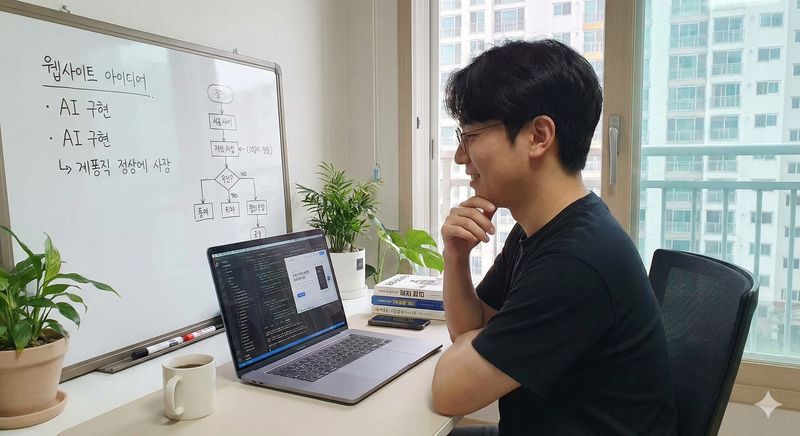
Prologue: The Frustration of Those Days
"That's not quite what I had in mind..."
I muttered this to myself countless times walking out of meeting rooms. I had a vivid picture in my head — the user presses this button, this screen appears, these colors, this flow. But to make that image real, I had to pass through gate after gate.
Explain it to the planner. Request it from the designer. Coordinate with the developer. At each stage, the image in my head warped a little more. The final product was clearly different from what I'd originally envisioned. But so much time and effort from so many people had already been invested that I could only say, "Sure, let's go with this."
Now, working with AI, everything has changed.
The Collaboration Dilemma: The Endless Loop of Persuasion
Don't get me wrong — I'm not against collaboration itself. Bringing together different experts to create synergy is genuinely valuable. The problem was the communication cost baked into the process.
The hardest part was never the technical challenge. It was accurately conveying the idea in my head to someone else.
Here's an example. Say you're planning a new web service. First, you write a planning document. Draw out screen flows, explain each feature, write user scenarios. Then you walk into a planning meeting.
"Why does this part need to work that way?" "Is this feature really necessary?" "I don't think users would actually behave like that."
You answer each question, persuade, sometimes compromise. Once the plan is finally locked in, you need to talk to the designer.
"Something clean but warm, you know..." "Clean but warm — what does that mean exactly?"
Translating the image in your head into words is incredibly difficult. You show color palettes, find and share reference sites, and when the first design draft arrives, you're stuck saying "Hmm... this isn't quite it" — over and over.
Then comes development, with its own set of hurdles.
"This feature is technically difficult to implement." "This approach could cause performance issues." "If we need to ship on time, we'll have to cut this feature."
These are all valid points — realistic constraints from experts' perspectives. But in the end, the service you originally dreamed of becomes something entirely different after round after round of compromise.
The Turning Point: Meeting AI
When I first tried an AI coding tool, I was skeptical. Can this really work? But curiosity won, and I started with something simple.
"Make a webpage where clicking a button opens a popup."
And it actually produced working code. Immediately. In real time.
Intrigued, I tried something more complex.
"Build a web app where users upload a photo and AI analyzes it and displays the results."
In the old world, this would have taken a week for the planning doc, two weeks for design, a month for development. With AI, I had a prototype in hours. It wasn't perfect. But seeing something from my head materialize in front of me — that was genuinely shocking.
What surprised me most was how AI understood my words. I'd say something vague like "when you press this button, something should kind of swoosh out" — and AI grasped what I was after. It almost seemed to understand me better than I understood myself.
The Changes I Actually Experienced
I felt this transformation most acutely when I built an actual web service.
Chatting with AI, I created a working web application, deployed it to a server, and integrated it with external AI services.
"I want a feature that analyzes photos taken with the camera." "Display the analysis results in a nice card layout." "Add icons so users can understand it easily."
I just described what was in my head, and AI implemented it in code. If I didn't like the result, I asked for changes immediately. No convincing anyone, no schedule negotiations, no budget worries.
How would it have gone the old way? Write a planning doc, find an outsourcing company, get a quote, sign a contract, check progress, request revisions, negotiate additional costs... Months, minimum. And not cheap.
But with AI, you can start building the moment an idea strikes. Before the mental image fades, before the passion cools — you just make it.
The MVP Revolution: Redefining Time
When building a new service, one of the most important things is creating an MVP — a minimum viable product — quickly to test the market's reaction.
Building an MVP used to be a major project in itself. Even for "minimum" functionality, you still had to go through planning, design, and development. Best case: 1-2 months. Usually: 3-4 months.
Not anymore. When an idea hits, you can have a prototype that same day. "What if I built a service like this?" pops into your head, and you immediately start chatting with AI — laying out screens, implementing core features, creating something that actually works.
The impact goes beyond just saving time. The idea validation cycle has become dramatically shorter. Previously, an MVP that took months to build and got no market response meant all that time was sunk cost. Now, you build a prototype in a day, gauge the reaction, and invest further only if there's potential.
Because the cost of failure has dropped, you can be bolder. "This is kind of a weird idea, but..." — you just build it anyway. It's not like it costs much. And sometimes those "weird ideas" reveal unexpected possibilities.
The Democratization of Creation: Anyone Can Build Now
What I'm most grateful for in the AI era is this: if you have an idea, you can build it.
Before, building anything required specific technical skills. Websites needed HTML, CSS, JavaScript. Apps needed Swift or Kotlin. Or you had to hire someone with those skills.
Not anymore. You just need to be able to describe your idea in words. AI handles the technical parts. Of course, complex systems still require specialized knowledge. But validating ideas, building prototypes, running small-scale services — those doors are now open to everyone.
This parallels the history of writing. Long ago, creating written documents required learning calligraphy, preparing paper and ink, and laboriously copying by hand. The printing press made knowledge easier to spread. Computers and word processors made document creation accessible to all. AI is the next step. Now anyone with an idea can create a digital product.
New Possibilities: The Age of the Solo Founder
This shift is a massive opportunity, especially for aspiring entrepreneurs.
Starting a startup used to require, at minimum, a team of a planner, a designer, and a developer. You couldn't do it alone. Great ideas with no team to execute them stayed ideas forever.
Now, solo entrepreneurship is genuinely feasible. AI can fill the roles of designer, developer, and even parts of the marketer role. It won't do everything perfectly. But for the early stages — validating an idea, acquiring first customers, building a foundation — one person can absolutely handle it.
I'm experimenting with this possibility right now. Attempting things that would have been impossible before. And if I fail? I'll just try something else. The cost of trying has dropped that dramatically.
Epilogue: The Value of Ideas
What matters most in the AI era? I believe it comes down to the idea.
The value of technical implementation skills is declining rapidly — AI does that now. But deciding what to build, what problems to solve, what value to deliver to people — that's still a human job.
We might be living in the best era in history. The barriers to turning a mental image into reality have never been this low.
There was a time when I'd walk out of meeting rooms silently frustrated, thinking "That's not what I meant..." Now I just build it. If I don't like it, I change it. I can transfer what's in my head directly into reality.
AI has improved many things, but for me, the biggest change is this: I no longer have to rely on others. I can build my own ideas with my own hands.
And that freedom — you can't truly understand it until you've experienced it yourself.