2026: AI Tools Have Completely Changed How I Work — From an Engineer in Seoul
An Unbelievable Transformation
January 2026 — and I'm still amazed every single day at work.
Compared to just a year ago, productivity with AI tools has improved beyond comparison. Tasks that used to take days now wrap up in hours. Areas that required specialized knowledge are now accessible much faster with AI assistance.
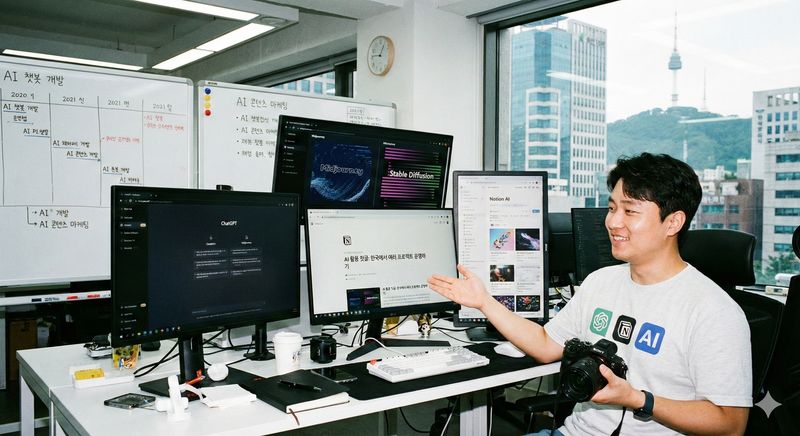
AI adoption is spreading rapidly in Korea right now. Not just in large corporations, but small and medium businesses and even individuals are using AI tools in all sorts of ways. In my own daily work, I rely on four core AI tools: ChatGPT, Gemini, Claude, and Claude Code.
The Four AI Tools I Use
ChatGPT — The Evolved All-Purpose Assistant
ChatGPT is my go-to general-purpose tool for everyday use.
Quick brainstorming, organizing ideas, drafting simple documents — it's the first thing I turn to when I just need to ask something. It handles multiple languages naturally, which makes it great for translation and language learning too.
As of January 2026, OpenAI is running the GPT-5 series. GPT-5 launched in August 2025, followed by GPT-5.1 in November and GPT-5.2 in December. GPT-5.2 is available in three modes — Instant, Thinking, and Pro — and excels particularly in professional knowledge work.
Gemini — The Hub of Google's AI Ecosystem
Google's Gemini has evolved well beyond a simple chatbot into a comprehensive AI platform.
Gemini 3 Pro launched in November 2025, and Gemini 3 Flash followed in January 2026 as the default model in the Gemini app. Its image analysis capabilities are excellent while API pricing remains very affordable, making it especially valuable for tasks involving large volumes of images.
What's even more noteworthy is the ecosystem of AI tools that work alongside Gemini. NotebookLM excels at document analysis and research, and seamless integration with Google Search, YouTube, and Google Drive pushes work efficiency even higher.
Claude — A Deep-Thinking Partner
Anthropic's Claude is my most trusted thinking partner.
Claude Opus 4.5 launched in November 2025 and remains the most powerful frontier model available. Its ability to read long texts, analyze logically, and — most importantly — understand context and respond appropriately is outstanding. When I need to think deeply about a complex problem or analyze a lengthy document, Claude is where I turn.
Claude's natural English output is excellent, and this blog is written with Claude's help as well. Beyond translation, it advises on natural phrasing and cultural nuance.
Claude Code — The Game Changer
The most impactful tool by far has been Claude Code.
Claude Code is an AI development assistant that operates directly in the terminal — it handles code writing, debugging, and file operations, covering nearly every aspect of development work. First released in February 2025, it went GA in May, and has since evolved to version 2.1.
It dramatically cuts development time and serves as a reliable partner for solving complex problems. A case where a Google principal engineer's year-long work on a distributed systems architecture was replicated by Claude Code in one hour illustrates just how powerful this tool can be.
Why Use Multiple AI Tools?
"Isn't one AI tool enough?" you might wonder.
In practice, each tool has its own strengths. It's like cooking — a knife, a frying pan, and a pot all serve different purposes.
| Use Case | Tool |
|---|---|
| Quick responses and daily tasks | ChatGPT |
| Image processing and research | Gemini / NotebookLM |
| Deep analysis and writing | Claude |
| Coding and development | Claude Code |
Using each tool for what it does best dramatically boosts overall efficiency.
The Shift from 2024 to 2026
In early 2024, AI tools were at a "useful but imperfect" stage.
ChatGPT would sometimes state things incorrectly. Image recognition wasn't as sharp as it is today. Code generation could handle simple scripts but struggled with complex applications.
As of January 2026, the landscape has completely changed.
With the arrival of GPT-5.2, Gemini 3, Claude Opus 4.5, and other latest-generation models, AI response accuracy has improved massively — evolving from "usable" to "reliable." The biggest shift is that AI has gone from being a "tool" to being a "collaborator."
A Dramatic Leap in Productivity
So how much has productivity actually improved?
Tasks I used to outsource, I now complete myself. Technical problems that required consulting an expert, I solve through AI conversation.
It's not just about saving time. The range of what I can do has expanded dramatically.
- Complex data analysis with NotebookLM
- Multilingual content creation with Claude
- Web application development with Claude Code
By leveraging each tool's strengths, I can accomplish far more as an individual. This isn't mere efficiency — it's an expansion of personal capability.
Looking Ahead in the AI Era
Even now in 2026, AI evolution shows no signs of slowing.
Competition between OpenAI, Google, and Anthropic is intensifying, and model development is accelerating. Keeping up with the pace of change isn't easy, but that's also what makes it exciting.
On this blog, I'll continue sharing what I learn from hands-on experience with AI tools, along with a front-row view of AI adoption here in Korea.
I hope these perspectives from Seoul offer some useful insights for readers everywhere.
Next time, I'll dive into specific use cases and practical examples for each AI tool.
Stay tuned.