How to Get from Incheon Airport to Seoul – A Complete Guide (The Subway Is Your Best Bet!)
A thorough comparison of transportation options from Incheon Airport to Seoul. Covers fares, travel times, and routes for the AREX subway, airport bus, and taxi, plus how to get to Hongdae, Myeongdong, and Seongsu, and how to use a T-money card.
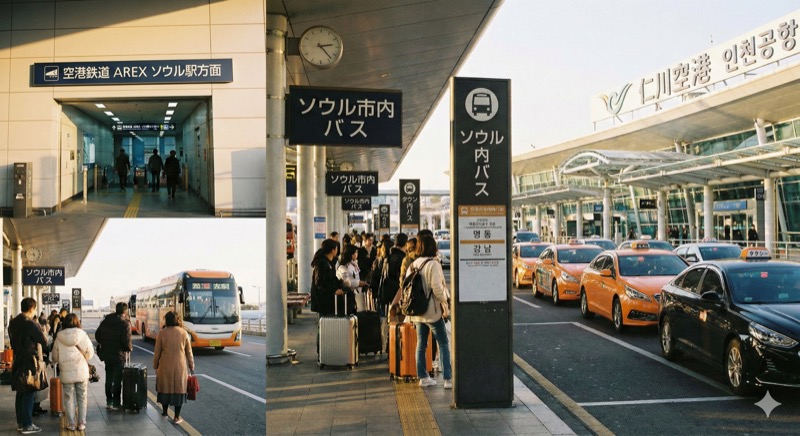
The first question most visitors face after landing in Korea is: "How do I get from Incheon Airport to Seoul?" I went through the same deliberation when I first arrived, but now I can say it clearly -- the subway (Airport Railroad Express, or AREX) is by far the best option. Today, I'll break down the best routes from Incheon Airport to three of Seoul's most popular neighborhoods: Hongdae (Hongik University area), Myeongdong, and Seongsu.
1. Subway (AREX Airport Railroad) -- The Best Option
Underneath Incheon Airport, there's a train line called the AREX (Airport Railroad Express) that connects directly to Seoul Station. There are two types of trains: the all-stop commuter train and the express train.
The all-stop commuter train stops at every station along the way and takes about 60 minutes to reach Seoul Station. The fare is around 5,050 won (roughly $3.50 USD) with a transit card, which is incredibly affordable. Trains run every 5 to 10 minutes, so you'll never wait long. Personally, this is the one I use most often.
The express train runs nonstop from Incheon Airport to Seoul Station in about 43 minutes. All seats are reserved and free Wi-Fi is available, making it a comfortable ride. The fare is 13,000 won ($9 USD) if booked in advance, or 17,700-18,300 won ($12-13 USD) if purchased on-site. If speed and comfort are your priority, the express is a solid choice.
Why I Recommend the Subway
There are three big reasons I recommend the subway above all else. First, it's completely unaffected by road traffic, so you arrive on time every time. Buses and taxis can take over 90 minutes if they hit traffic, but the subway always gets you to Seoul in a consistent, predictable time. Second, it's the cheapest option by far -- just 5,050 won (~$3.50 USD) to Seoul Station on the commuter train. Third, Seoul Station connects to the rest of the subway network, making it easy to transfer and reach virtually anywhere in the city.
By the way, the commuter train also stops at Hongik University (Hongdae) Station. If your accommodation is in Hongdae, you can simply get off there instead of going all the way to Seoul Station. It takes about 50 minutes from Incheon Airport to Hongdae Station, and the fare is around 4,750 won (~$3.30 USD).
2. Airport Bus (Limousine Bus) -- Convenient When You Have a Lot of Luggage
Airport buses run routes directly to various parts of Seoul, so if there's a stop near your destination, they can be a convenient choice. They're especially handy if you have multiple large suitcases, since luggage can be stored in the compartment below the bus.
The fare for a premium limousine bus to central Seoul is about 17,000 won (~$12 USD). The K-Limousine bus operates routes to Myeongdong and Gwanghwamun, stopping at major hotel locations like City Hall, Euljiro (Lotte Hotel), and Gwanghwamun. Buses typically run at 15 to 30 minute intervals.
The biggest downside of the bus is that travel time varies wildly depending on traffic. Normally it takes about 70-80 minutes, but during rush hour it can stretch to nearly 2 hours. That's the main reason I prefer the subway. However, if there's a route that drops you right at your hotel's doorstep -- especially in areas like Myeongdong or Gangnam -- the bus can be a great choice.
You'll find ticket counters and bus stops just outside the arrivals lobby on the 1st floor of Incheon Airport Terminal 1. You can pay with a transit card, cash, or credit card.
3. Taxi -- Convenient but Expensive
Honestly, I almost never take taxis from the airport. The reason is simple: they're expensive.
A regular taxi from Incheon Airport to central Seoul costs roughly 60,000-100,000 won ($42-70 USD) depending on your destination. On top of that, there's a highway toll of 7,900 won ($5.50 USD). Late-night surcharges apply between 10 PM and 4 AM, pushing the price even higher. When you consider that the subway costs just 5,050 won (~$3.50 USD), a taxi is over 10 times more expensive.
Of course, if you have an enormous amount of luggage, are traveling in a group (where you can split the cost), or arrive late at night after public transit has stopped, a taxi may be your only option. In that case, the Kakao Taxi (Kakao T) app is useful -- it lets you check estimated fares in advance. The app is available in Korean, English, and Japanese.
One word of caution: at the airport, unlicensed drivers may approach you offering rides. These vehicles often charge more than regular taxis. Always use the official taxi stand.
Recommended Routes by Destination
Hongdae (Hongik University Area)
Take the AREX commuter train and get off directly at Hongik University Station. No transfers needed -- about 50 minutes, around 4,750 won (~$3.30 USD). The simplest and cheapest route. Hongdae is one of Seoul's most vibrant neighborhoods, packed with cafes, shopping, street food, and nightlife. Staying in this area also gives you easy access to the rest of Seoul.
Myeongdong
Take the AREX commuter train to Seoul Station (60 minutes), then transfer to Subway Line 4 and ride one stop to Myeongdong Station. Total travel time is about 70 minutes, total fare about 5,050 won ($3.50 USD) thanks to the free transfer. Myeongdong remains one of the most-visited neighborhoods for international tourists, and it's a paradise for shopping and food.
Seongsu
Seongsu has rapidly become one of Seoul's trendiest neighborhoods. It's often called "Seoul's Brooklyn," with hip cafes, pop-up stores, and K-fashion boutiques lining its streets. Take the AREX to Hongik University Station, then transfer to Subway Line 2 and ride to Seongsu Station (25 minutes). Total travel time is about 80 minutes, total fare about 5,050 won ($3.50 USD) with the free transfer.
How to Use a T-money Transit Card -- A Must-Have for Visiting Korea
One thing you absolutely need for getting around Korea is a transit card. The most widely used one is the T-money card.
Where to buy: You can purchase one at any convenience store (CU, GS25, 7-Eleven) in the Incheon Airport arrivals lobby. The card itself costs about 2,500-4,000 won (~$1.75-2.75 USD), and you load it with whatever amount you'd like. Just say "T-money juseyo" (T-money, please) at the register.
How to charge: You can add money at convenience stores or at transit card charging machines found in subway stations. Many charging machines have English-language options. Loading about 10,000 won (~$7 USD) should be enough for getting around Seoul for a day or two.
How to use: T-money works on the subway, city buses, airport buses, and even for payments at convenience stores. Just tap the card on the reader when boarding. One of the best features is the free transfer system -- if you transfer from the subway to a bus (or vice versa) within 30 minutes, there's no additional fare. This transfer system can save you a significant amount on transportation costs.
Note: There are also mobile transit card options using your smartphone's NFC, but these may not work with phones purchased outside of Korea. For most visitors, buying a physical T-money card is the simplest and most reliable option.
Summary
To sum it up, the best way to get from Incheon Airport to Seoul is the AREX commuter train. It's cheap, runs on a reliable schedule, and connects to the rest of Seoul's subway network. With just one T-money card, you can ride the subway and buses freely, so the first thing to do when you land is grab a T-money card at a convenience store. Have a wonderful trip to Korea!