Why Are Korean Cafes So Huge? Everything You Need to Know About Korea's Unique Cafe Culture
One of the first things that surprises visitors to Korea is the cafe scene.
"Why are they so big?" "Why are there so many?" "Why is everyone on a laptop?" "Why is the cafe packed at 10 PM on a weeknight?"
When I've visited the United States, I noticed a very different coffee culture. The cozy neighborhood coffee shop where a barista carefully crafts your pour-over -- that has its own charm. But Korean cafe culture has evolved in a completely different direction.
Today, I'll take you through what makes Korean cafe culture so unique.
More Cafes Than Convenience Stores: Korea, the Coffee Republic
Korea has a staggering number of cafes. As of 2024, the total number of coffee shops nationwide has surpassed 100,000 -- that's more than the number of convenience stores. The number of coffee brands alone has reached 886, which is over 200 more than fried chicken franchises (669).
Koreans consume roughly 405 cups of coffee per person per year, putting the country just behind Finland in global rankings. The world average is 152 cups, meaning Koreans drink more than double that. A survey found that 76% of Korean coffee drinkers have at least one cup every day.
Walking down any street, it's perfectly normal to see 3-4 cafes on a single block. A Starbucks next to a Mega Coffee, next to a Twosome Place, next to an independent cafe. Sometimes there are even different cafes on the 1st and 2nd floors of the same building.
Here's a fun fact: Starbucks Korea has more locations than Starbucks Japan. South Korea currently ranks third in the world for Starbucks locations, behind only the US and China. Starbucks Korea's revenue hit approximately 2.9 trillion won (~$2 billion USD) in 2023.
Why Korean Cafes Are So Big
Unlike small independent coffee shops you might find in many Western cities, Korean cafes tend to be enormous. Cafes with over 100 seats are common, and many have 2 or 3 floors. In suburban areas, you'll even find warehouse-style mega-cafes with their own parking lots.
So why did they get so big? There are several reasons.
1. Cafes Are More Than Just a Place to Drink Coffee
They're places to study, work, meet friends, go on dates, and hold business meetings. All of these activities happen simultaneously in a single cafe. Accommodating all these purposes requires a lot of space.
2. Many Koreans Live in Small Apartments
Seoul apartments, especially studios and small units, aren't really set up for hosting guests. So cafes serve as a "second living room." People meet friends, catch up with parents, or spend time with their significant other at cafes instead.
3. Social Media and Instagram Culture
Cafes with stylish interiors, spacious layouts, and photo-worthy spots attract the most customers. The concept of an "Instagrammable" cafe is a real competitive advantage. This has driven cafes to create increasingly unique and spacious environments.
4. The Economics of Commercial Rent
Ground-floor commercial rent in Korea is the most expensive. Many cafes opt for more affordable 2nd floors or basements, compensating by securing much larger spaces.
The "Cagongjok" (Cafe Study Tribe)
Korea has a word for it: cagongjok (카공족) -- literally "the tribe of people who study at cafes."
You might see the occasional student studying at a Starbucks in any country, but Korea takes this to another level. Visit a cafe on a weekday afternoon and more than half the seats will be occupied by students and office workers with laptops and textbooks spread out. During exam season, that proportion climbs even higher.
Why do Koreans study at cafes?
Focus. At home, there are too many distractions -- beds, TVs, smartphones. Many people find that the ambient noise and awareness of others in a cafe actually helps them concentrate.
A change of environment. The simple act of getting dressed and going out puts you in "work mode." Many people feel more productive studying at a cafe than sitting at home in pajamas.
Korean cafes are especially welcoming to the cagongjok because of these features:
- Free Wi-Fi at virtually every cafe
- Power outlets at most seats
- An atmosphere where staying for hours is perfectly acceptable
- Many cafes open 24 hours
- No one bats an eye if you sit for 3-4 hours with one drink
In many Western countries, finding a cafe with reliable Wi-Fi, available outlets, and a willingness to let you camp out for hours can be hit-or-miss. In Korea, it's the default.
Study Cafes: A Uniquely Korean Concept
Korea also has a business called the "study cafe" (스터디카페). Despite the name, it's closer to a time-based co-working or self-study space.
Study cafes originated in Korea. They combine the comfortable atmosphere of a cafe with the focused environment of a library.
Key features of study cafes:
- Various pricing plans: 2-hour passes, day passes, 100-hour monthly passes
- Many are unmanned (you pay at a kiosk)
- Most are open 24 hours
- Different zones: partitioned desks, open tables, study rooms
- Free drinks (coffee, tea) included
- Separate areas for laptop users and quiet zones
There are thousands of these study cafes across the country, concentrated near cram school districts and university areas. During exam season, it can be hard to find an empty seat.
Budget Coffee vs. Premium Coffee: A Polarizing Market
The biggest shift in Korea's cafe market recently has been the explosive growth of budget coffee brands.
Brands like Mega Coffee, Compose Coffee, and Paik's Coffee sell an Americano for 1,500-2,000 won (~$1-1.40 USD). Compare that to a Starbucks Americano at around 4,500 won -- budget brands are less than half the price.
How Koreans use different cafes:
| Purpose | Preferred Cafe |
|---|---|
| Morning caffeine fix on the way to work | Budget coffee brands |
| Chatting with friends, dates | Starbucks, Twosome Place |
| Extended studying/working | Large cafes or study cafes |
| Aesthetic photos for social media | Indie cafes with unique interiors |
It's common to "grab a 1,500-won Americano from Mega Coffee in the morning, then meet friends at Starbucks in the evening" -- using different cafes for different purposes throughout the day.
Unique Aspects of Korean Cafe Culture
Korean cafes have some distinctive customs that may surprise visitors.
Vibrating Pagers
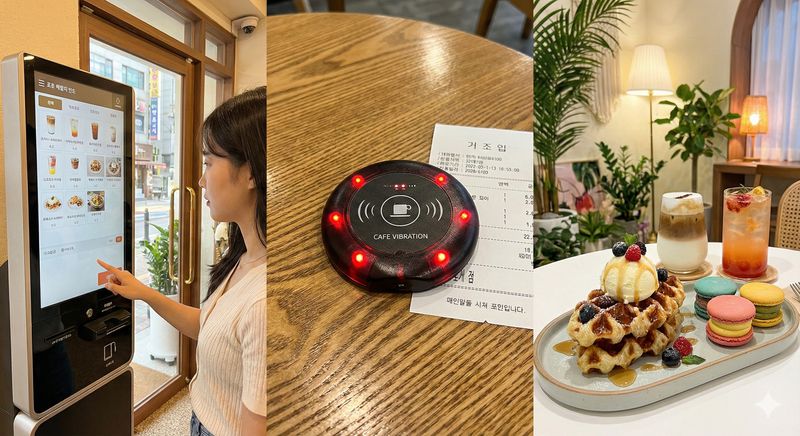
After ordering, you receive a vibrating pager. Sit down and wait -- when your drink is ready, the pager buzzes. Instead of staff bringing drinks to your table, you pick them up yourself. Think of it like a fast-casual restaurant in the US, but at a cafe.
Kiosk Ordering
Many cafes have self-service kiosks (touchscreen ordering machines) where you place and pay for your order without interacting with a person. Convenient for most, though it can be challenging for older customers less familiar with digital interfaces.
Tumbler Culture
Many cafes offer discounts if you bring your own reusable tumbler. Collecting stylish tumblers has become a hobby in itself.
Dessert Cafes
Korean cafes go far beyond just coffee. Many offer an extensive dessert menu -- cakes, macarons, croffles (croissant-waffles), brunch items, and more.
How Korean Cafe Culture Compares
| Aspect | Korea | Typical in the US/West |
|---|---|---|
| Size | Large, multi-story cafes common | Smaller, cozier cafes common |
| Hours | Open late, even 24 hours | Often close by early evening |
| Power outlets | Available almost everywhere | Hit-or-miss |
| Wi-Fi | Free as standard | Sometimes unavailable or limited |
| Staying for hours | Totally normal | Can feel awkward |
| Ordering | Kiosks, self-pickup | Counter service typical |
| Primary purpose | Study, work, socializing -- all at once | Primarily enjoying coffee |
It's not a matter of one being better than the other -- each has evolved to match its own culture and lifestyle.
If You're Visiting Korea, Here's What to Experience
Recommended Experiences
- Many large cafes have 2nd and 3rd floors -- head upstairs and find a seat with a great view
- Neighborhoods like Seongsu-dong, Yeonnam-dong, and Ikseon-dong are full of indie cafes with incredible interiors
- Cafes with views of the Han River are worth seeking out
- Try a budget coffee brand (Mega Coffee, Compose Coffee) at least once
- Among cafe desserts, the "croffle" (croissant-waffle) is a Korean trend worth trying
Good to Know
- Power outlets and Wi-Fi are available almost everywhere, so don't worry about that
- Staying for a long time is perfectly fine -- no one will rush you
- Ordering an "Americano" is the safest bet and the most popular drink among Koreans
- Card payment is standard -- almost no cafe is cash-only
Final Thoughts
Korean cafe culture has transcended the simple act of drinking coffee to become a genuine part of daily life. It's where people work, study, socialize, and relax. That's why the cafes are so big, so numerous, and open so late.
It's a different kind of charm from the quiet, intimate coffee shop experience you might be used to -- and if you visit Korea, I highly recommend exploring as many different cafes as you can.
Sources
- Statistics Korea Service Industry Survey (2024)
- Open Survey Cafe Trend Report 2024
- Euromonitor Coffee Consumption Survey
- Korea Agro-Fisheries & Food Trade Corporation (aT) Coffee Import Statistics