Work Culture in South Korea: What Office Life Is Really Like
A deep dive into South Korean work culture from an insider perspective — commute habits, overtime, office drinking culture, employment norms, and how things are changing.
South Korea is known globally for its rapid economic development, tech giants like Samsung and Hyundai, and its incredibly hard-working population. But what is day-to-day office life actually like for Korean workers?
As a Korean office worker myself, I want to share an honest look at the realities of work culture here — the good, the bad, and the changing.
Commute Culture: Getting to Work on Time
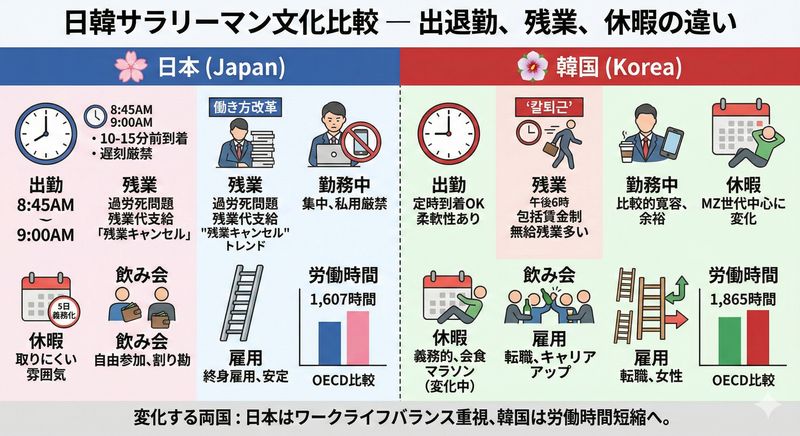
In Korea, if your start time is 9 AM, arriving by 9 AM is generally fine. Unlike some countries where showing up 10-15 minutes early is an unwritten expectation, Korean workplaces tend to be more relaxed about this — as long as you're not late.
That said, things are changing even more. Many companies, especially in the tech sector, have adopted flexible working hours. Some offices let you start anywhere between 7 AM and 10 AM, as long as you put in your required hours. This shift has been a huge quality-of-life improvement for workers with long commutes or family obligations.
Overtime: The Ongoing Battle
South Korea has historically been known for long working hours, and overtime culture has been a significant social issue.
The government introduced a 52-hour workweek cap (40 regular hours + 12 overtime hours) in 2018, which brought major changes. Before that, working 60-70 hour weeks was not uncommon.
However, challenges remain. Many companies use a "comprehensive wage" (pogoal imgeum) system, where overtime pay is bundled into the base salary — meaning you often don't get extra compensation for staying late. The fact that there's a specific Korean word, "kaltogeun" (칼퇴근), meaning "leaving work exactly on time," tells you something: leaving at the scheduled time still feels like a notable act rather than the default.
Interestingly, younger workers — Korea's MZ generation (Millennials and Gen Z) — are pushing back hard against overtime culture. Work-life balance has become a top priority, and many openly refuse to stay late without good reason.
The Office Atmosphere: How the Workday Feels
During working hours, the atmosphere varies quite a bit depending on the company. Traditional large corporations (chaebols) tend to be more formal, while startups and tech companies are considerably more relaxed.
In most Korean offices, it's fairly common to take a coffee break, check your phone briefly, or handle a quick personal errand during the day. KakaoTalk — Korea's dominant messaging app — is used for both work and personal conversations, so the line between work chat and personal chat can get blurry.
Compared to workplaces in some other countries where personal device use is strictly monitored, Korean offices generally have a more relaxed attitude about these small breaks, as long as your work gets done.
Vacation Culture: Earned but Hard to Use
Korean workers are legally entitled to 15 days of paid annual leave in their first year, with an additional day added every two years (up to a maximum of 25 days). On top of that, there are about 15 public holidays per year.
On paper, that's pretty generous. In practice? Many workers hesitate to use their full vacation allotment. There's a lingering cultural pressure — a sense that taking time off burdens your colleagues or signals a lack of dedication.
The good news is that this is changing, especially among younger workers. A 2025 survey found that more than half of Korean office workers completely disconnected from work during their summer vacation. The shift toward actually using your entitled leave is well underway.
Hoesik: The Korean Company Dinner
One of the most distinctive aspects of Korean work culture is hoesik (회식) — the company dinner and drinking gathering.
Traditionally, hoesik was practically mandatory. A typical evening might go through multiple rounds: first stop for dinner, second stop for drinks at a bar or karaoke, sometimes a third stop at yet another venue. This "hoesik marathon" was a major part of corporate bonding culture.
In Western work cultures, after-work drinks are usually optional and casual. In Korea, declining a hoesik invitation — especially one organized by a senior colleague — used to be seen as a serious social misstep.
However, things have shifted dramatically, particularly after COVID-19. The number of hoesik events has decreased significantly, and when they do happen, they're more likely to end after one round. Individual choice is increasingly respected, and younger workers feel less pressure to attend.
Employment: Stability vs. Mobility
Korean career culture has its own distinct character. Unlike countries with strong traditions of lifetime employment at a single company, job-hopping every 3-5 years is quite normal in Korea. In fact, staying at one company for too long can sometimes be viewed negatively — as if you've stopped growing professionally.
This mobility has its advantages: workers can advance their careers more quickly and negotiate better compensation. But there's a flip side. Early retirement pressure hits hard in your 40s and 50s, and job security — especially for older workers — remains a significant concern.
Many Koreans in their 50s find themselves starting small businesses or taking on entirely new careers, not always by choice. The contrast between the dynamic early career years and the uncertainty of later years is one of the defining tensions of Korean work life.
Working Hours by the Numbers
South Korea consistently ranks among the countries with the longest working hours in the OECD.
| Country | Annual Working Hours (2024) |
|---|---|
| South Korea | 1,865 hours |
| United States | ~1,810 hours |
| United Kingdom | ~1,530 hours |
| Germany | ~1,340 hours |
The good news is that Korean working hours are declining rapidly. A decade ago, the average exceeded 2,000 hours. The government is also incentivizing shorter workweeks — some companies are now experimenting with a 4.5-day workweek, with government subsidies to support the transition.
A Work Culture in Transition
Korean work culture is in the middle of a significant transformation. The traditional emphasis on long hours, hierarchy, and company loyalty is giving way to a new set of values centered on work-life balance, individual autonomy, and efficiency.
| Aspect | Traditional Korean Work Culture | Emerging Trends |
|---|---|---|
| Hours | Long overtime expected | 52-hour cap, flexible schedules |
| Drinking culture | Mandatory hoesik | Optional, fewer rounds |
| Employment | Lifetime loyalty valued | Job-hopping normalized |
| Communication | Top-down, hierarchical | Flatter structures in tech/startups |
| Vacation | Hesitant to use | Increasing usage, especially among younger workers |
The pace of change is remarkable. What was considered normal even five years ago would feel outdated in many Korean workplaces today.
For anyone interested in working in Korea or doing business with Korean companies, understanding both the traditional norms and the direction of change will serve you well.
I hope this gives you a useful window into what Korean office life is really like. In future posts, I'll continue sharing more about Korean culture and daily life.