The Complete Guide to Korea's T-money Transit Card -- A Must-Have for Any Visitor
Everything you need to know about Korea's T-money card: where to buy it, how to load money, how to use it, transfer discounts, refunds, and how it compares to WOWPASS and NAMANE.
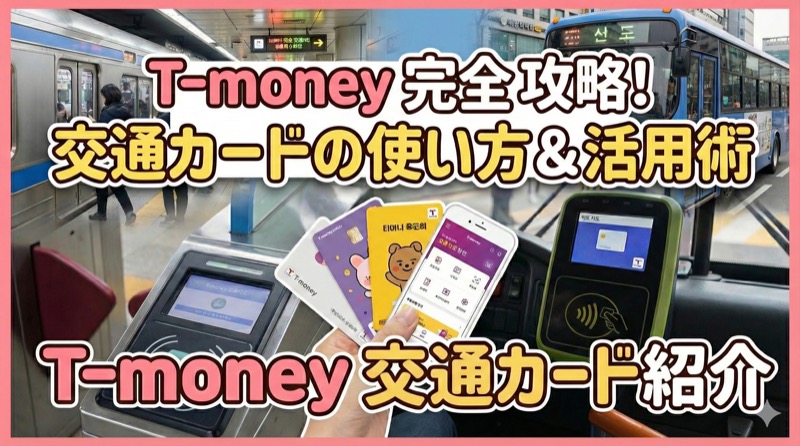
If you're planning a trip to Korea, there's one item you absolutely need to know about: the T-money transit card.
Think of it as Korea's equivalent of London's Oyster card or a contactless transit card. With just this one card, you can ride the subway, buses, and taxis, and even pay at convenience stores. It's the single most useful thing you can have for getting around Korea.
In this guide, I'll cover everything: where to buy T-money, how to load it, how to use it, how to get a refund, and some insider tips that'll save you money.
What Is T-money?
T-money is Korea's most widely used prepaid transit card. First introduced in Seoul in 2004, it now works across the entire country.
It works just like a contactless transit card in most major cities around the world. Load money onto it in advance, then tap it on the reader at subway gates or bus terminals -- the fare is automatically deducted.
Using T-money gives you a discount compared to paying cash, and you also get additional savings from the transfer discount system. It eliminates the hassle of buying individual tickets each time, making it practically essential for any visit to Korea.
Where to Buy
T-money cards are easy to find at several locations throughout Korea.
Airport
At Incheon or Gimpo Airport, you'll find T-money vending machines near the airport railroad gates. Since you can start using it immediately for your ride into Seoul, buying one right when you land is the smart move.
Convenience Stores
GS25, CU, 7-Eleven, emart24 -- all major Korean convenience store chains sell T-money cards. Since there's a convenience store on virtually every block, this is the easiest way to get one. Just say "T-money juseyo" (T-money, please) at the register.
Subway Stations
Ticket machines and information desks inside subway stations also sell T-money cards. Major tourist stations like Seoul Station, Hongik University Station, and Myeongdong Station have machines with English-language options.
Card Prices
A standard plain card costs about 3,000 won (~$2 USD). Character-themed cards (Kakao Friends, BT21, etc.) run 4,000-5,000 won and make popular souvenirs. There are even keychain-style T-money tags you can clip onto your bag.
How to Load Money
Your T-money card starts with a zero balance, so you'll need to load (charge) it before use.
Subway Station Charging Machines
Every subway station has dedicated T-money charging machines. Many have English-language guides on screen. Just place your card on the reader, insert cash for the amount you want to add, and you're done.
Convenience Stores
You can also load money at any convenience store counter. Hand the clerk your card and the cash you want to add, and say "chungjeon hae juseyo" (please charge this). They'll handle the rest.
Important Notes
Currently, T-money can only be charged with cash -- foreign credit cards don't work for loading. So make sure you have some Korean won bills on hand. You can load in increments of 1,000 won, and for sightseeing purposes, 20,000-30,000 won (~$14-21 USD) should last several days of transit.
As of July 2025, T-money can be added to Apple Wallet on iPhones. However, charging still requires a Korean-issued credit card, so the physical card remains more practical for most tourists.
How to Use
Subway
Just like using a contactless card anywhere in the world. Tap your card at the turnstile when entering and again when exiting -- two taps total. A beep confirms the transaction.
Bus
Tap your card on the reader near the entrance when you board. Tap again when you exit. Forgetting to tap off is important to avoid -- it can prevent the transfer discount from applying and may result in a penalty on your next ride.
Taxi
Most Seoul taxis accept T-money. When you arrive at your destination, tell the driver "kaduro halgeyo" (I'll pay by card) and tap your card on the terminal.
Convenience Stores and More
Any store displaying the T-money logo accepts it as payment, just like using a debit card. Handy for small purchases.
T-money's Biggest Perk -- Transfer Discounts
The real magic of T-money is its transfer discount system.
If you pay cash, each subway-to-bus transfer costs a separate fare. But with T-money, transfers between subway and bus are treated as a single continuous fare -- meaning you pay little or no additional cost.
The basic rule: transfer within 30 minutes of exiting (60 minutes between 9 PM and 7 AM), and the discount applies. You can make up to 4 discounted transfers per trip.
For example, if you exit the subway and transfer to a bus, cash riders would pay two separate fares. With T-money, the subway base fare covers the bus as well. Over the course of a multi-day trip with many transfers, this adds up to real savings.
Checking Your Balance and Getting a Refund
Balance Check
Your balance appears on the screen every time you tap through a subway turnstile. You can also check it by placing your card on any charging machine at a subway station.
Refund
Before leaving Korea, you can get your remaining balance refunded. This can be done at subway station service centers or at certain convenience stores (7-Eleven, CU, emart24). Note that a 500-won processing fee is deducted, and convenience stores have refund limits (20,000 won at 7-Eleven; 30,000 won at CU and emart24).
Your T-money balance never expires, so if you plan to return to Korea, you can simply keep the card with its remaining balance for next time.
WOWPASS and NAMANE -- Other Options Worth Knowing
Recently, tourist-friendly cards with built-in T-money functionality have appeared.
WOWPASS
Combines T-money transit with a prepaid shopping card you can use at stores and restaurants. Available at dedicated kiosks in airports and major tourist areas. It also has a built-in foreign currency exchange feature, making it very convenient.
NAMANE
The standout feature is the ability to create a custom-designed card with your own photo. This has made it popular among K-pop fans who design cards featuring their favorite artists. It also supports loading from foreign-issued credit cards, which is a significant advantage for visitors.
If you only need transit, T-money is sufficient. If you want transit and shopping in one card, consider WOWPASS or NAMANE.
Insider Tips
Start with about 20,000 won (~$14). Seoul's base subway fare with T-money is 1,550 won (as of June 2025), so 20,000 won covers 10+ rides. Just add more as needed.
Early-bird discount. Between the first train and 6:30 AM, T-money users get an additional 20% discount. Great if you're an early riser.
You can tap through your bag or wallet. No need to take the card out -- it reads through most materials. Just be careful not to keep other contactless cards right next to it, which can cause read errors.
Summary -- One T-money Card and You're Set
T-money should be one of the very first things you pick up when arriving in Korea. A single card covers subway, bus, taxi, and convenience store purchases -- virtually all your transit and small-payment needs.
It's easy to buy, works just like any contactless transit card you may have used elsewhere, and the transfer discount system can save you a meaningful amount on transportation.
When you land in Korea, grab a T-money card first. It'll make getting around the country much easier and more affordable.