10 Korean Phrases That Will Make Your Trip to Korea So Much Better
Ten essential Korean phrases for travelers, from greetings to ordering food to finding the restroom. Each phrase comes with pronunciation and real-world usage tips.
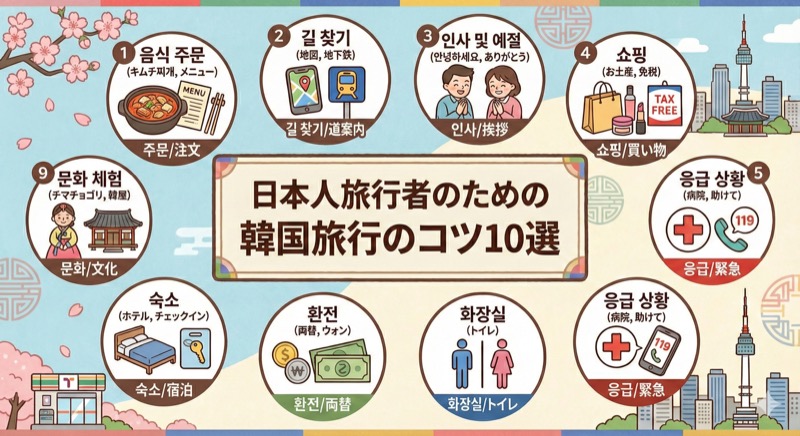
Planning a trip to Korea? With the global wave of K-pop and Korean dramas, more international visitors are traveling to Korea every year. English is widely spoken in Seoul's tourist areas, but knowing even a handful of Korean phrases will transform your travel experience.
Koreans genuinely light up when a foreigner speaks Korean to them. You don't need to be fluent -- not even close. Just one or two words in Korean can completely change the vibe of an interaction and bridge the gap between visitor and local.
Here are 10 Korean phrases that will come in handy during your trip, with pronunciation guides and tips on when to use them.
1. 안녕하세요 (Annyeonghaseyo)
The most fundamental greeting. It works any time of day -- morning, afternoon, or evening. Use it when checking into your hotel, entering a restaurant, walking into a shop -- basically everywhere.
In Korea, shop staff will usually greet you with "annyeonghaseyo" when you walk in. Simply saying it back makes an instantly positive impression.
Among close friends, Koreans shorten this to just "annyeong," but as a visitor, stick with the full "annyeonghaseyo" -- it's always appropriate.
2. 감사합니다 (Gamsahamnida)
This means "thank you" and is arguably the phrase you'll use more than any other during your trip. Getting out of a taxi, receiving your food at a restaurant, finishing a purchase at a convenience store -- you'll find dozens of opportunities to use it every day.
Koreans respond with genuine warmth when they hear "gamsahamnida" from a visitor. This one phrase alone can make your entire trip feel warmer.
There's also a more casual version -- "gomawoyo" -- but "gamsahamnida" is the safest choice for travelers.
3. 이거 얼마예요? (Igeo eolmayeyo?)
"How much is this?" An absolute must-have at markets, street stalls, and when shopping.
At Korea's traditional markets, items often don't have price tags. Point at what you want and ask "igeo eolmayeyo?" Most vendors will show you the number on a calculator or use their fingers, so even if you don't understand spoken numbers, you'll be fine.
Especially useful at Myeongdong, Namdaemun Market, and Dongdaemun Market.
4. 맛있어요 (Mashisseoyo)
"It's delicious." Let's be honest -- food is probably the highlight of any Korean trip. Bibimbap, samgyeopsal (BBQ pork belly), tteokbokki (spicy rice cakes), Korean fried chicken -- when you taste something amazing, say this.
When you tell a restaurant owner or server "mashisseoyo," they'll beam with pride. At smaller family-run restaurants and street stalls, a sincere "mashisseoyo" might even earn you an extra side dish or a complimentary drink.
5. 주세요 (Juseyo)
"Please give me ___." This works in restaurants, cafes, shops -- practically anywhere you're ordering or buying something.
The beauty of this phrase is its simplicity. Point at what you want and say "igeo juseyo" (this one, please). Point at a menu item and say "igeo juseyo." Done.
At a cafe: "Americano juseyo." At a convenience store: "bongtu juseyo" (a bag, please). Just swap in whatever word you need. If you only memorize one phrase, make it this one.
6. 화장실 어디예요? (Hwajangsil eodiyeyo?)
"Where is the restroom?" A non-negotiable phrase for any traveler.
Large shopping malls and subway stations have clear signage, but at smaller restaurants and cafes, you may need to ask. "Hwajangsil eodiyeyo?" will get you pointed in the right direction every time.
One thing to know: in many Korean buildings, restrooms are located in the hallway shared by all tenants, not inside individual restaurants. Sometimes they require a door code, but the staff will tell you if you ask.
7. 괜찮아요 (Gwaenchanayo)
"It's okay" / "I'm fine" / "No thanks." This is one of the most versatile phrases in Korean and covers a surprising range of situations.
Someone apologizes to you? "Gwaenchanayo" = "Don't worry about it." A shopkeeper asks if you need a bag? "Gwaenchanayo" = "No thanks, I'm good." Someone offers help you don't need? "Gwaenchanayo" = "I appreciate it, but I'm fine."
One phrase, many uses -- extremely handy.
8. 여기요 (Yogiyo)
Similar to "Excuse me!" -- specifically used to get a server's attention in a restaurant.
Many Korean restaurants have call buttons at the table, but when there isn't one, just call out "yogiyo!" In Korean dining culture, this is perfectly normal and not rude at all, so don't hesitate.
Use it when you want to order more food, ask for water, or request the check.
9. 얼마나 걸려요? (Eolmana geollyeoyo?)
"How long will it take?" Useful when you're on the move or waiting for food.
In a taxi: "Myeongdong-kkaji eolmana geollyeoyo?" (How long to Myeongdong?). Waiting in line at a popular restaurant: "Eolmana geollyeoyo?" to find out the wait time.
Popular Korean restaurants can have waits of 30 minutes to over an hour. Knowing the wait in advance helps you plan your day more efficiently.
10. 또 올게요 (Tto olgeyo)
"I'll come again." Say this as you leave a restaurant or shop you really enjoyed.
This phrase is more than just a farewell -- it conveys "I loved your place and I want to come back," which means a lot to the owners. The effect is especially powerful at small, family-run restaurants and cafes.
On your last day in Korea, saying "tto olgeyo" at a spot you visited multiple times will make the goodbye feel truly meaningful.
Summary -- A Little Korean Goes a Long Way
There you have it -- 10 Korean phrases for your trip. None of them are complicated. They're short, simple, and easy to remember. But the impact of actually using them is huge.
Koreans are genuinely delighted when visitors make the effort to speak Korean. Your pronunciation doesn't need to be perfect -- not even close. Just having the courage to try opens up real connections with the people you meet.
On your next trip to Korea, put these 10 phrases to use. I guarantee your experience will be warmer, richer, and more memorable than ever before.