The Complete Guide to Korean Convenience Stores -- A World of Their Own
Everything you need to know about Korean convenience stores: the major brands, must-try foods and drinks, unique cultural quirks, and how to make the most of them during your Korea trip.
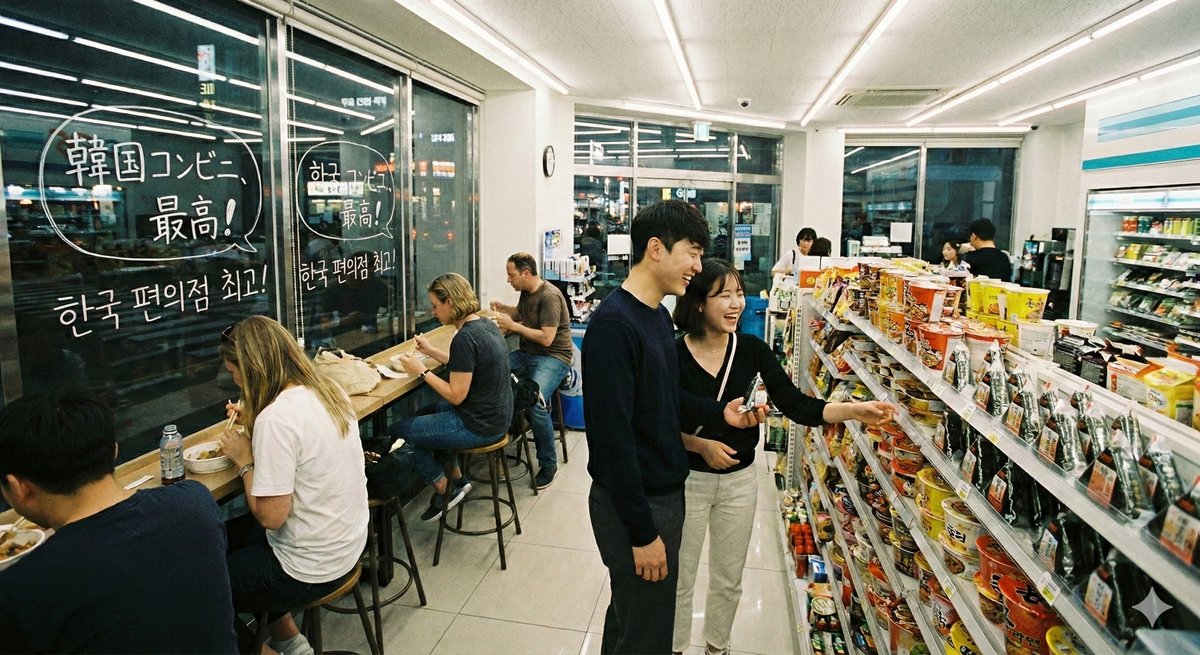
Travel around Korea and you'll encounter convenience stores absolutely everywhere. In central Seoul, it's barely an exaggeration to say there's one every 50 meters. While convenience stores exist worldwide, Korean ones have their own distinctive character and charm. In this article, I'll walk you through everything that makes Korean convenience stores special.
The Major Brands
The three convenience store brands you'll see most often in Korea are CU (pronounced "see-you"), GS25, and 7-Eleven. CU and GS25 are the two dominant players, each operating over 17,000 locations nationwide. 7-Eleven, which many visitors will recognize, ranks third in Korea. Other chains like emart24 and Ministop also exist but have fewer locations.
Unlike the US, where 7-Eleven tends to dominate in most markets, the Korean convenience store landscape is a fierce two-way battle between CU and GS25. It's not uncommon to see a CU and a GS25 literally next door to each other in the same building.
Must-Try Foods
Korean convenience stores have developed their own distinctive food culture that's absolutely worth exploring.
Samgak-gimbap (triangle kimbap) is the signature convenience store snack. It looks like a Japanese onigiri but with uniquely Korean fillings -- tuna mayo is the classic, along with bulgogi, kimchi fried rice, and spicy tuna. Priced at around 1,000-1,500 won (~$0.70-1 USD), they're slightly cheaper than their Japanese counterpart.
Lunchboxes (dosirak) have dramatically improved in quality over the past few years. You'll find options inspired by Korean home cooking: spicy pork stir-fry (jeyuk bokkeum), kimchi stew (kimchi jjigae), bibimbap, and more. Prices run about 3,500-5,500 won (~$2.50-4 USD). Celebrity and chef collaborations are frequent, and these limited-edition lunchboxes often go viral on social media and sell out fast.
The instant noodle section is a highlight in itself. Korea is one of the world's top consumers of instant noodles, and convenience stores stock dozens of varieties. The best part? Most stores provide free hot water, so you can eat them right there. Try Buldak Bokkeum Myeon (the famous ultra-spicy noodle), Shin Ramyun, or Jin Ramen.
Then there's the hot food counter -- something that sets Korean convenience stores apart. Many locations prepare food in-store: hot dogs, tteokbokki (spicy rice cakes), fishcake skewers (odeng), and mandu (dumplings). In winter, a cup of warm fishcake broth from the store is a quintessential Korean experience.
Drinks and Desserts Worth Trying
The drink section is packed with things you won't find back home. The star is Banana Flavored Milk (banana-mat uyu) -- a sweet, banana-flavored milk drink in a distinctive chubby jar-shaped container. It's been a beloved childhood drink for generations of Koreans. Strawberry and chocolate versions exist too, but the original banana is the undisputed champion.
Soju and beer are readily available. Korea's signature spirits -- Chamisul and Cheoeum Cheoreom -- come in numerous flavors, including fruity varieties. One uniquely Korean phenomenon: it's perfectly acceptable to buy drinks at a convenience store and enjoy them at the outdoor tables out front. This is called "pyeonmaek" (short for "convenience store beer") and it's a genuine part of Korean social life.
On the dessert front, Korean convenience stores have been rapidly upping their game. Each brand develops its own private-label desserts, and some become bona fide cultural phenomena -- like CU's Yonsei Milk Cream Bread, which caused sellout frenzies when it launched.
What Makes Korean Convenience Stores Different
A few things stand out compared to convenience stores in the US or Europe.
First, almost every Korean convenience store has tables and chairs -- either inside or right out front. People routinely eat purchased food, drink beer, and just hang out there. Korean convenience stores function as informal social gathering spots, not just retail shops.
Second, payment is almost entirely cashless. The vast majority of customers pay by card or mobile payment (Samsung Pay, Kakao Pay, etc.). Korea's cashless rate already exceeds 90%. Visitors can use Visa or Mastercard without any issues.
Third, Korean convenience stores offer a wide range of services beyond shopping: package delivery pickup and dropoff, ATMs, transit card charging, utility bill payments, and event ticket printing. A uniquely Korean feature is the "1+1" and "2+1" promotions -- buy-one-get-one-free and buy-two-get-one-free deals that run constantly and are a major draw.
Fourth, while Korean convenience stores are mostly open 24/7 (similar to the US), staffing is different -- they're almost entirely run by part-time workers. Working at a convenience store, known as "pyeonuijeom alba," is one of the most common part-time jobs for Korean college students.
Tips for Visitors
Here are a few ways to make the most of Korean convenience stores during your trip.
Use them for breakfast. Finding a sit-down breakfast in Korea can be tricky since Korean breakfast culture doesn't revolve around restaurants the way it does in the US. A convenience store lunchbox, sandwich, or triangle kimbap makes for a quick, affordable morning meal.
Look for 1+1 deals. When items are on buy-one-get-one-free, grab the second one to share with your travel companion. These promotions are typically marked with bright yellow stickers or tags.
Download the store apps for discounts. CU has "Pocket CU" and GS25 has "Uridongne GS" -- both offer discount coupons. Worth a try if you're comfortable navigating a Korean-language app.
And here's my short list of absolute must-tries: Banana Flavored Milk, Buldak Bokkeum Myeon (spicy fire noodles), sotteok-sotteok (alternating sausage-and-rice-cake skewers), a spicy triangle kimbap, and any PB-brand dessert. These are visitor favorites for good reason.
Korean convenience stores are far more than just places to buy things -- they're one of the most accessible windows into Korean food culture and daily life. When you visit Korea, definitely step into a few and explore the shelves. You might be surprised by what you discover.