Korean Greetings for Every Situation -- Travel, Daily Life, and Business Phrases
Korean greetings organized by situation: basics, dining, travel, and business. Each phrase includes romanized pronunciation so you can start using them right away.
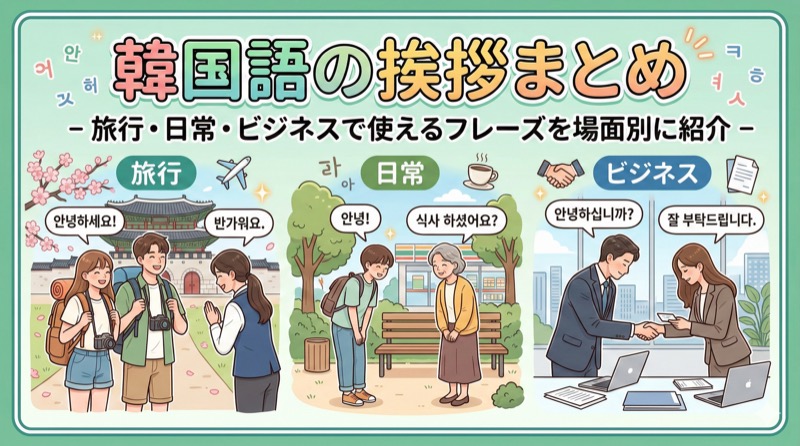
Whether you're planning a trip to Korea, watching a K-pop livestream, or chatting with Korean friends and colleagues -- you've probably thought at some point, "I wish I knew at least the basic Korean greetings."
Korean greetings share some similarities with other East Asian languages but also have their own unique characteristics. One important feature is Korea's formality system -- there are different levels of politeness depending on your relationship with the person you're speaking to and the situation. This can actually feel intuitive once you get the hang of it.
In this article, I've organized commonly used Korean greetings by situation, drawing from real daily usage. Each phrase includes romanized pronunciation, so you can use them even without reading Korean script (Hangul).
A Few Things to Know First
Before diving in, here's some helpful context.
Korean has three main levels of speech formality. Hamnida-che (formal polite) is used in news broadcasts and business settings. Heyo-che (standard polite) is the most common everyday level -- what you'd use with shopkeepers, acquaintances, and anyone you've just met. Banmal (casual speech) is for close friends and people younger than you.
Think of it roughly as: hamnida-che = "would you be so kind," heyo-che = regular "please" and "thank you," banmal = how you talk to your best friend. This article primarily covers heyo-che (standard polite) with some hamnida-che (formal polite) versions for business and formal contexts.
One important cultural note: age matters a lot in Korea. Even a one-year age difference means the younger person should use polite language. When Koreans meet for the first time, one of the first questions is often about age -- it determines the level of formality for the entire relationship.
Essential Everyday Greetings
"Hello" -- 안녕하세요 (Annyeonghaseyo)
The single most important greeting in Korean. Unlike English, which has "good morning," "good afternoon," and "good evening," Korean uses annyeonghaseyo all day long. One phrase covers every time of day -- nice and simple.
Among close friends, it shortens to "annyeong." In very formal settings, it becomes "annyeonghasimnikka."
"Thank you" -- 감사합니다 (Gamsahamnida) / 고마워요 (Gomawoyo)
Gamsahamnida is the formal "thank you," widely used in public and professional settings. Fun fact: "gamsa" comes from the Chinese characters for "gratitude" (感謝), so if you know any Chinese characters, it's easy to remember.
For everyday use, gomawoyo is more common. Among friends, it shortens further to "gomawo." As a visitor, gamsahamnida is your safe go-to.
"I'm sorry" / "Excuse me" -- 죄송합니다 (Joesonghamnida) / 미안해요 (Mianhaeyo)
Joesonghamnida is the formal apology -- think "I sincerely apologize." Mianhaeyo is the everyday "sorry," and among friends it becomes just "mian." If you watch Korean dramas, you've definitely heard this one.
Here's an interesting cultural difference: in English, "excuse me" covers both apologies and getting someone's attention. In Korean, calling someone over (like a restaurant server) uses a completely different phrase: "jeogiyo" or "yogiyo." In a restaurant, you'd call out "jeogiyo!" instead of "excuse me!"
"Goodbye" -- 안녕히 가세요 / 안녕히 계세요
Korean has something English doesn't: two different goodbyes depending on who's leaving.
If the other person is leaving (and you're staying): "Annyeonghi gaseyo" -- literally "go in peace." If you're leaving (and they're staying): "Annyeonghi gyeseyo" -- literally "stay in peace." If you're both leaving: you both say "annyeonghi gaseyo."
It might seem confusing at first, but once it clicks, you realize there's a beautiful warmth to it -- wishing someone safe travels or a peaceful stay.
Casual farewells among friends include "jal ga" (take care / bye), "bai-bai," and "tto bwa" (see you again).
Dining Phrases
"Bon appetit" / "Let's eat" -- 잘 먹겠습니다 (Jal meokgesseumnida)
Literally "I will eat well." Like saying grace or "bon appetit," it's said before a meal. It's especially important to say when dining with someone older or when someone is treating you -- it's a sign of respect and gratitude.
One cultural difference: Koreans don't put their hands together in prayer before saying it. They simply say the phrase and begin eating.
"Thank you for the meal" -- 잘 먹었습니다 (Jal meogeosseumnida)
Literally "I ate well." Said after finishing a meal. Especially meaningful when someone has paid for your food.
This connects to an important Korean dining custom: the person who invites typically pays. Going Dutch (splitting the bill) is less common than in the US. When a senior or older person takes you out to eat, they usually insist on covering the whole bill. That makes "jal meogeosseumnida" carry real weight -- it's a genuine expression of thanks.
Shopping and Travel Phrases
"Welcome" -- 어서 오세요 (Eoseo oseyo)
You'll hear this the moment you walk into virtually any Korean shop. It literally means "come quickly" and carries a strong sense of welcome.
Interestingly, unlike "welcome" in English (which is mainly used in commercial settings), Koreans also say "eoseo wa" (the casual version) when welcoming friends to their home.
"Check, please" -- 계산해 주세요 (Gyesanhae juseyo)
Used at restaurants and cafes. "Gyesan" comes from the Chinese characters for "calculation" (計算). In Korean restaurants, you typically either call the server to your table or go to the register to pay.
"This one, please" -- 이거 주세요 (Igeo juseyo)
A universal phrase for shopping and ordering. "Juseyo" means "please give me," and you can swap in whatever you need: "jeogeo juseyo" (that one, please), "mul juseyo" (water, please).
Business Phrases
"Good work today" -- 수고하셨습니다 (Sugohasyeosseumnida)
This is a common workplace expression, but it comes with an important caveat: it flows downward in the hierarchy. A boss says it to employees; it's natural that way. But an employee saying it to their boss can come across as presumptuous.
When leaving the office before your boss, the safe phrase is: "meonjeo deureogagesseumnida" (I'll head out first) -- Korea's version of "I'm heading out, have a good evening."
"Nice to work with you" / "Please take care of things" -- 잘 부탁드립니다 (Jal butakdeurimnida)
Used in first meetings and business emails. Jal (well) + butak (request/favor) + deurimnida (I humbly give). It's the standard closing for introductions in professional settings.
More casual: "jal butakhaeyo." Among friends: "jal butakhae."
"Nice to meet you" -- 처음 뵙겠습니다 (Cheoeum boepgesseumnida)
The formal first-meeting greeting, literally "I'm seeing you for the first time." Often followed by a self-introduction, just as you'd expect.
A slightly warmer alternative: "mannaseo bangapseumnida" (I'm glad to meet you).
Seasonal and Special Occasion Phrases
New Year -- 새해 복 많이 받으세요 (Saehae bok mani badeuseyo)
"May you receive lots of blessings in the new year." Korea's traditional New Year (Seollal) follows the lunar calendar, falling in late January or February, but this greeting works for January 1st as well.
During Seollal, children perform a deep bow called sebae to their elders and receive sebaetdon -- essentially New Year's money (similar to red envelopes in Chinese culture or otoshidama in Japan).
Birthday -- 생일 축하해요 (Saengil chukahaeyo)
"Happy birthday." If you're a K-pop fan, you've probably seen this all over social media on your favorite idol's birthday.
Cheers -- 건배 (Geonbae)
Literally "dry cup" -- the same characters as "cheers" in Chinese (乾杯). At Korean drinking gatherings, everyone raises their glass and shouts "geonbae!" Another common toast is "wihayeo!" (to [something]!).
The Culture Behind the Greetings
If you've read this far, you may have noticed that Korean greetings share structural similarities with other East Asian languages -- formal and informal levels, different expressions based on context, and some shared vocabulary roots from Chinese characters.
At the same time, there are uniquely Korean touches. The "good work today" phrase that flows only downward in hierarchy. The two different goodbyes depending on who's leaving. These nuances reveal a lot about Korean culture itself.
One more physical difference: Koreans bow when greeting, but not as deeply as you might see in Japanese culture. Even in business, a slight head nod is the norm rather than a full 90-degree bow.
These "similar but different" details are part of what makes learning Korean greetings so interesting.
Wrapping Up
Korean greetings are surprisingly approachable. The formality system makes intuitive sense once you see it in action, and many words have cognates if you know any Chinese characters or other East Asian languages.
Start with just two: annyeonghaseyo (hello) and gamsahamnida (thank you). With those alone, you can navigate a trip to Korea or brighten any interaction with a Korean speaker. The gesture of greeting someone in their own language -- even imperfectly -- is itself the most powerful form of communication.
I hope this article sparks your interest in Korean greetings and inspires you to give them a try.