A Late-30s Dad's Take on Modern K-Pop -- It's Really Changed
How K-pop looks through the eyes of a Korean dad in his late 30s. From the pre-streaming era to BTS going global, multinational groups, and the explosion of musical diversity -- a personal reflection on how far things have come.
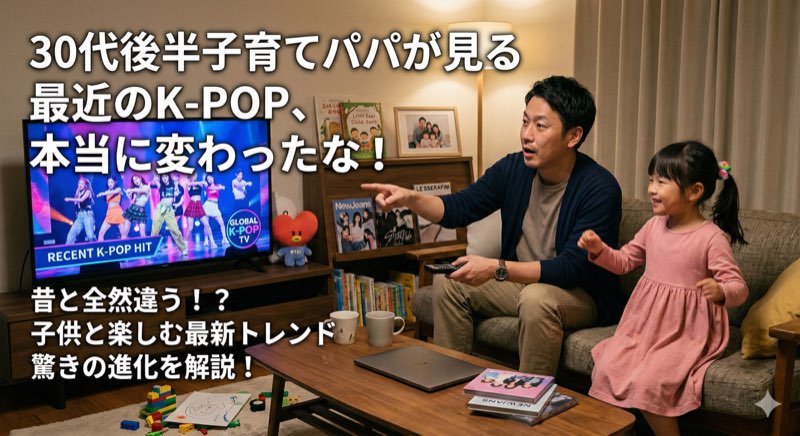
These days, when the topic of K-pop comes up, nobody asks me "Oh, you're into idols?" anymore. Instead, the first question is usually "Who's the most popular right now?" As a dad in my late 30s raising a young kid, I look at K-pop from a very different angle than teenagers or twenty-somethings. But maybe that's exactly why I notice certain things more clearly -- and find them more fascinating.
When Hearing Foreign Music Was an Effort in Itself
Looking back to my elementary and middle school days, accessing foreign culture was a completely different experience than it is now. If you wanted to listen to music from overseas, you had to physically go to a record store and buy an import CD, or wait for the occasional pop song to come on the radio. Online shopping from abroad was unimaginable, and the content itself was limited.
Things got a little better when mp3 players came along. I vividly remember hunting down music files one by one and loading them up. But even then, the limitations were clear. It was a fundamentally different world from today, where you can pull up any music video on YouTube and check global charts in real time.
When Almost No One Abroad Knew Korean Artists
If hearing foreign music in Korea was hard, Korean music reaching the rest of the world was even harder. I lived abroad for a while, and while there were a handful of people who showed interest in Korean culture, it was genuinely rare. When I told people "I'm from Korea," the most common response was something like "Oh, Samsung?" -- and that was about it.
So when I see what K-pop has become today, I'm honestly stunned. And proud. Watching BTS dominate the Billboard charts and BLACKPINK headline Coachella, I can't help but think: "We couldn't have even imagined this back in our day."
Everything Changed After BTS
K-pop's international push had been building since the second generation of idol groups. TVXQ (DBSK) found major success in Japan, and BIGBANG and Girls' Generation built followings across Asia. But back then, it still felt like "popularity within Asia."
The seismic shift came with BTS. Number one on the Billboard Hot 100. A speech at the United Nations. That was the moment the world acknowledged K-pop as a mainstream force in the global pop market. After that, international reach wasn't something special anymore -- it became the expectation.
Multinational Groups: Surprising at First, Normal Now
One of the most interesting things I've noticed watching K-pop recently is how naturally multinational the groups have become. The inclusion of members from all over the world has become seamless.
TWICE's Mina, Sana, and Momo from Japan were among the early trailblazers. Then came LE SSERAFIM's Sakura and Kazuha, and members from the US, Australia, Thailand, China, and beyond across dozens of groups. Watching them switch effortlessly between Korean and their native languages, performing on stages around the world, is genuinely impressive.
When I first saw this trend, I found it surprising. Korean-Japanese relations, for instance, have been historically complicated. But seeing artists from both countries harmonize so naturally through music was striking. Now, though, it just feels completely normal. Different nationalities aren't a source of friction -- they're an asset that enriches each group's appeal. We live in an era where talented young people from around the globe are moving to Korea with the dream of "I want to be a K-pop idol."
Cultural Fusion Has Made the Music More Diverse
As members from diverse backgrounds come together, the musical spectrum has expanded enormously. If early K-pop was primarily dance-pop, today you'll find hip-hop, R&B, EDM, city pop, Latin influences, and more coexisting within the same genre. The performances have become incomparably more elaborate too -- precision group choreography is just the baseline. Add in narrative-driven music videos and entire fictional universes built around group concepts, and K-pop has become a form of total entertainment.
As a guy in his late 30s, I catch myself watching these stages thinking "Wow, that's actually incredible." Watching music videos with my kids and discussing things like "this group has this kind of concept" or "this song blends these genres" has become a surprisingly fun part of family life.
Final Thoughts
The biggest change I feel is this: there's now so much shared global content that people around the world can enjoy together. When I was a kid, just accessing foreign culture required real effort. Now, one smartphone connects you to the world's music and culture in real time. And Korean content is right there, holding its own on the global stage. That's pretty remarkable to witness.
Will this wave last forever? I don't know. Trends always shift. But the fact that people across the world are right now passionate about the same music, building a shared culture that transcends borders -- that feels like something genuinely good. Watching alongside my kids to see what groups, what music, what culture emerges next might just be turning into one of my favorite hobbies.