Seollal: Korea's Lunar New Year -- A Deep Dive into Korea's Biggest Holiday
A thorough guide to Seollal, Korea's most important traditional holiday. From ancestral rites and deep bows to rice cake soup and gift-giving, here's what Lunar New Year really looks like in Korea.
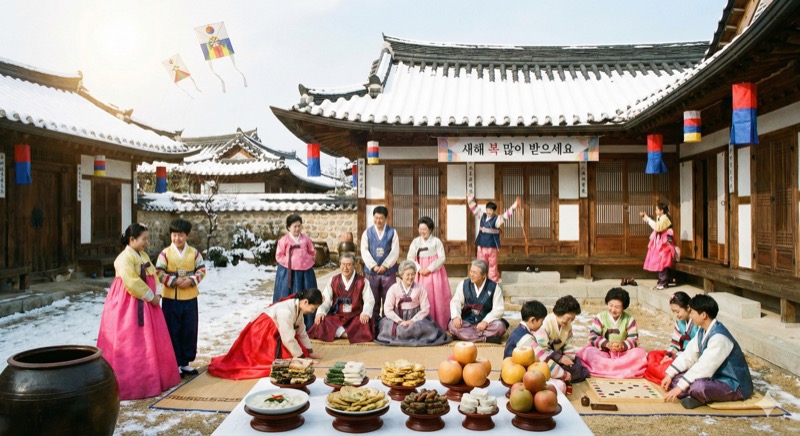
Korea has its own version of New Year's that's quite different from the January 1st celebrations most Westerners are used to.
It's called Seollal -- the Lunar New Year, celebrated on the first day of the lunar calendar. It's Korea's single biggest traditional holiday.
Today I'll walk you through how our family celebrates Seollal, with a look at what makes it unique.
What Is Seollal?
Seollal falls on the 1st day of the 1st month of the lunar calendar, making it one of the most important holidays of the year in Korea.
Koreans get three consecutive days off -- the day before, the day of, and the day after Seollal. Since the lunar calendar shifts relative to the Western calendar, the exact dates change each year. Checking "when is Seollal this year?" is practically a January ritual for every Korean.
It usually falls between late January and mid-February, roughly the same time as Chinese New Year (Spring Festival) and Vietnamese Tet.
For context: While Korea does observe January 1st (called "Sinjeong"), it's just a single-day holiday with minimal fanfare. The real celebration -- the equivalent of Christmas and Thanksgiving rolled into one -- is Seollal.
The Great Migration: Korea's Holiday Traffic
As the Seollal break approaches, the entire country experiences a massive homecoming rush.
Millions of people who live and work in Seoul and the capital region all head to their hometowns at once. Highways that normally take 3-4 hours become 8-hour odysseys. KTX (Korea's bullet train) and bus tickets sell out the moment they go on sale.
Americans might compare it to Thanksgiving travel -- but imagine if nearly the entire country was trying to travel on the same three days. The scale is staggering.
To avoid the worst of the traffic, some families now leave in the middle of the night before the holiday or shift their travel to off-peak times.
How Seollal Day Unfolds
The morning of Seollal follows a traditional sequence that has been passed down through generations. Here's what a typical day looks like.
1. New Clothes: "Seolbim"
On Seollal morning, the whole family puts on new clothes -- a tradition called "seolbim."
In the old days, everyone would wear hanbok (traditional Korean attire). Nowadays, most families just wear something new and presentable. The idea is to welcome the new year feeling fresh and clean.
For kids, it's a simple pleasure: getting to wear the new outfit that was bought just for the occasion.
2. Ancestral Rites: "Charye"
Once the family gathers, the first order of business is charye -- a formal ritual honoring ancestors.
An elaborate spread of food is arranged on a table according to specific rules: fruits, seasoned vegetables (namul), jeon (pan-fried savory pancakes), rice cakes, and rice wine, all placed in a prescribed layout. For example:
- "Eo-dong yuk-seo" -- Fish goes on the east side, meat on the west
- "Hong-dong baek-seo" -- Red fruits go east, white fruits go west
These rules vary by region and family, which can be daunting for newlyweds figuring out their in-laws' specific traditions -- a classic Seollal challenge.
Cultural note: While many Western holidays involve going to a church or public gathering, Seollal's spiritual element is centered in the home. The family table becomes the place of reverence.
3. The Deep Bow: "Sebae" and New Year's Money: "Sebaetdon"
After charye comes the moment kids look forward to most: sebae.
Sebae is a deep, formal bow -- children and younger family members kneel and bow deeply to their parents, grandparents, and elder relatives, saying:
"Saehae bok mani badeuseyo" (May you receive many blessings in the new year)
The elders respond with warm words of encouragement: "Stay healthy," "Study hard," "Have a great year."
Then comes the reward: sebaetdon -- New Year's money!
Like the tradition of red envelopes during Chinese New Year or gifts during Christmas, sebaetdon is cash given to younger family members. Here's how it works:
| Korea (Sebaetdon) | |
|---|---|
| Packaging | White envelopes or gift envelopes |
| Timing | Immediately after performing sebae |
| Typical amount (elementary school) | 10,000-50,000 won (~$7-35 USD) |
| Requirement | You must bow first -- no bow, no money! |
Kids with large extended families can walk away with a significant haul. In a sign of the times, some families now send sebaetdon digitally via bank transfer or KakaoPay (Korea's mobile payment app).
The Essential Seollal Foods
Tteokguk -- Korea's New Year Soup
The signature dish of Seollal is tteokguk -- a soup made with thinly sliced oval rice cakes simmered in a clear beef bone broth.
In Korea, there's a saying: "You don't age a year until you've eaten your tteokguk." It's that integral to the holiday. Visually, it might remind you of chicken noodle soup or wonton soup, but the oval-sliced rice cakes and clear, savory broth give it a unique character. It's typically topped with shredded egg and dried seaweed.
The broth is clean and mild -- very approachable for any palate.
Other Seollal Dishes
Beyond tteokguk, the Seollal table is loaded with delicious food:
- Japchae -- Glass noodles stir-fried with vegetables. A celebration staple
- Jeon -- Savory pancakes made with vegetables, seafood, and egg batter. Think small, flat fritters
- Galbi-jjim -- Braised short ribs. Every family has their own secret recipe for this show-stopper
- Sujeonggwa -- A sweet, cinnamon-ginger punch served as a traditional after-meal drink
Preparation starts days in advance, with the whole family pitching in. The jeon requires so much frying that many Koreans say "when you smell jeon frying, you know Seollal is here."
Traditional Games the Whole Family Plays
Once everyone is full, it's time for traditional games.
Yutnori -- Korea's Team Board Game
Four wooden sticks are thrown, and players advance tokens on a board based on how the sticks land. It's a team-based strategy game -- simple rules, but surprisingly competitive. When extended family gathers for Seollal, teams form up and sometimes even put money on the line. The shouting and laughter make it a true Seollal tradition.
Neolttwigi -- Seesaw Jumping
Two people stand on opposite ends of a long board and take turns jumping, launching each other into the air. Traditionally a women's game.
Yeon Nalligi -- Kite Flying
Flying kites is a traditional Seollal pastime. Korean kites have a distinctive shield-shaped design called "bangpaeyeon" that's quite different from the diamond kites common in the West.
Modern Seollal -- How Traditions Are Evolving
While Korea deeply values its traditions, the way people celebrate Seollal has been changing with the times.
Simplified charye: The elaborate ancestral rites that once required dozens of dishes are being scaled back. More families are ordering pre-made "charye sets" from department stores or online, reflecting the realities of dual-income households.
Travel instead of homecoming: Some families now use the long holiday for international vacations. Korea's airports get noticeably busier with outbound travelers during Seollal.
Video call sebae: Performing sebae over video call to distant relatives has become commonplace, a practice that took root during the COVID pandemic and stuck around.
"Holiday syndrome" (myeongjeol jeunghugun): The stress of cooking, cleaning, and navigating family dynamics during Seollal has a name -- "holiday syndrome." It disproportionately affects women, and there's a growing movement to share responsibilities more equitably.
Seollal Phrases to Know
If you have Korean friends or acquaintances, sending one of these messages around Seollal will definitely make them smile:
| Korean | Romanization | Meaning |
|---|---|---|
| 새해 복 많이 받으세요 | Saehae bok mani badeuseyo | May you receive many new year blessings |
| 즐거운 설날 보내세요 | Jeulgeoun Seollal bonaeseyo | Have a happy Seollal |
| 건강하세요 | Geonganghaseyo | Stay healthy |
| 올해도 잘 부탁합니다 | Olhaedo jal butakamnida | Looking forward to another great year together |
"Saehae bok mani badeuseyo" is the classic Seollal greeting -- the one everyone uses. It's worth memorizing.
Summary
Seollal is more than just a holiday -- it's a time for reaffirming family bonds and expressing gratitude to ancestors.
It shares some surface-level similarities with other New Year celebrations around the world (gift-giving, special food, family gatherings), but traditions like sebae and charye are distinctly Korean and offer a fascinating window into the culture.
The way Seollal is celebrated is gradually modernizing, but the core -- "the family comes together and shares a meal" -- hasn't changed.
If you have Korean friends or colleagues who take time off around Seollal, try greeting them with "saehae bok mani badeuseyo!" You're sure to get a warm smile in return.