I Had No Idea How Hard It Would Be to Introduce AI to Other People
What I learned from trying to share AI with people around me. I just wanted to spread the excitement, but somehow I ended up becoming a free AI concierge service.
Every morning when I wake up and grab my phone, there's one thing I do first.
I look at the latest AI news and let myself be amazed.
"Wait, it can do that now?" — that daily hit of wonder and excitement has become my morning routine. AI is evolving at a truly staggering pace, and we're well past the point of just being impressed from the sidelines. I'm now actively using AI in my daily life and at work, building my own programs, trying out new AI services. Every day brings new discoveries.
"I Want to Share This Excitement"
Maybe it's just human nature. When you discover something incredible, you want to tell the people around you. It's not about bragging — you genuinely want your family and friends to experience the same sense of wonder. AI makes life more convenient and work easier. With nothing but good intentions, I started introducing AI to the people in my life.
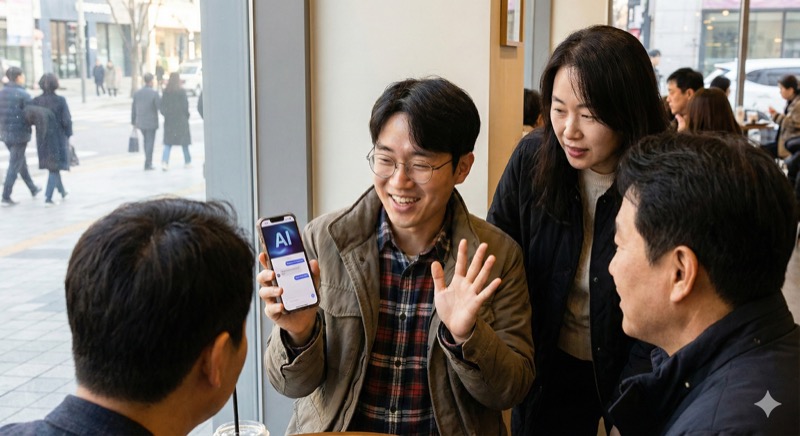
"This AI is amazing at writing." "It can even generate images." I'd explain all of this with wide eyes and obvious enthusiasm.
But I've decided to stop.
I'm Done Recommending AI to People
I know that sounds cold, but it's a conclusion born from experience.
When I introduce AI, everyone's initial reaction is great. "Wow, that's incredible!" they say. And in that moment, it feels good.
But here's the problem: they're amazed, sure, but surprisingly few actually incorporate AI into their own lives or work. At most, they'll ask a chat-based AI a question or two and call it a day. Almost nobody takes the next step — building something with it, experimenting with new tools, really digging in.
And honestly, that's fine. People are different. The real issue is what happens next.
The "So You Do It for Me" Problem
After introducing AI, there's a very high probability of hearing this:
"Oh wow, that's cool. So can you use it to do [something] for me?"
Before I knew it, it had become my job. The other person has no intention of learning it themselves — they've already assumed I'll handle it. What started as sharing a cool tool somehow turned me into a free AI concierge service.
And then comes the really tricky part. When AI doesn't produce a perfect result on the first try, I hear:
"See, it didn't even work right the first time." "This isn't what I had in mind."
And the criticism isn't directed at the AI — it's aimed at me. "You're the one who said it was amazing" — as if I'd personally guaranteed the output quality.
Knowing How to Work With AI Makes All the Difference
This is where I realized there's a huge gap.
Because I use AI every day, I know full well it doesn't produce perfect results on the first try. AI can't read the exact image in my head. The first output is always a starting point — a rough draft.
From there, you refine through dialogue. "Adjust this part." "Go in this direction." Through that back-and-forth, you gradually arrive at what you actually wanted. Sometimes that iterative process even reveals what you truly needed, something you hadn't consciously realized yourself.
But most people expect perfection from AI on the very first attempt. And when they started using it because of my recommendation, that expectation is even higher. "You said it was amazing" becomes pressure that lands squarely on my shoulders.
So I'm Keeping It to Myself Now
After enough of these experiences, I reached a conclusion.
I'm done recommending AI to anyone. Family included. Friends too.
It might sound selfish, but I believe it's actually better for everyone involved. I'll keep waking up every morning amazed by AI's progress, and I'll keep applying it to my work and life. I've just decided to savor that joy privately.
Honestly, the AI tools I rely on most? I want to keep them as my "secret weapon." There's even a small part of me that doesn't want to spread the word about how good these tools really are — a little possessive, maybe, but there it is.
AI Is Truly Powerful Only for Those Who Discover It Themselves
What I've ultimately come to believe is that the only people who can truly harness AI are those who discover its potential on their own and choose to learn of their own volition.
When someone just gives it a try because they were told "it's amazing," they'll never unlock AI's real power. The people who benefit most are the ones who don't give up when things go wrong, who keep iterating, who genuinely enjoy the trial and error.
So even if someone around me shows interest in AI, I won't actively teach them anymore. I'll wait until they develop genuine curiosity on their own, start researching on their own, start experimenting on their own — and then maybe I'll give them a gentle nudge.
Because discovering AI should be something you find for yourself, not something that's pushed on you.
And so today, once again, I sit quietly with AI, telling no one, and whisper to myself, "This is incredible..." That secret pleasure is more satisfying than I can say.